
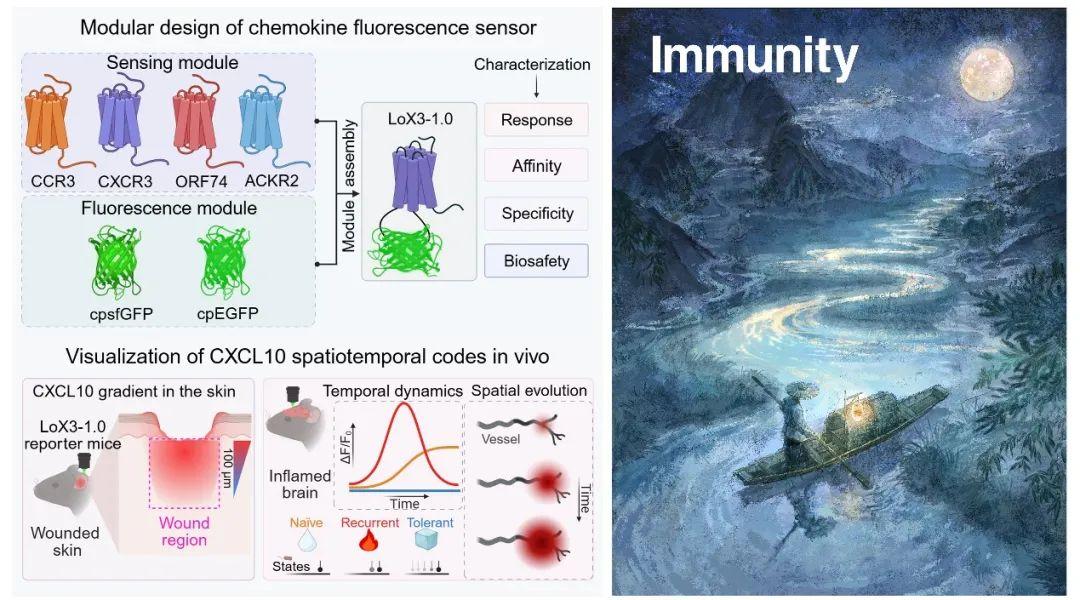
Chemokines are a class of extracellular guidance cues that are critical for the migration of cells during development and inflammation. However, there precise spatiotemporal distribution in the native in vivo context has been poorly characterized due to their limited detection methods. Using the GPCR-activation based sensor (GRAB) engineering strategy plus a modularly design methods, here we developed the first genetically-encoded fluroescent sensor based on the CXCR3 receptor that can sensitively track the dynamics of its corresponding chemokine CXCL9-11. Using such advanced tool, we mapped the immune context-dependent evolution of chemokine patterns in vitro and in vivo, revealing the multi-dimensional spatiotemporal patterns of chemokine that are precisely organized by the environmental cues. We also achieved the precise recording of the in vivo chemokine gradient along the blood vessels in the systemic inflammation model, revealing the progressive evolution of chemokine gradients across the inflammation states. Congratulations to Fengxue Xi and Chenyu Wang for their excellent contributions, and also for other lab members and collaborators for support!
Check our paper at here: Spatiotemporal dynamics of CXCL10 encode contextual immune information revealed by the genetically encoded fluorescent sensor: Immunity
We are eager to share the sensors to the whole community! The plasmids are available at Addgene and Wekwikgene, and we also created Cre-dependent reporter mice that are deposited at the Jackson Laboratory (040416 - GRAB-LoX3-1.0, LoX3-1.0, LSL-LoX3-1.0 Strain Details). Some viral constructs are also available from companies in China (contact BrainVTA and WZ Bioscience). Also, feel free to contact us (jingmiao@@cibr.ac.cn, delete one @) for reagents and collaborations!