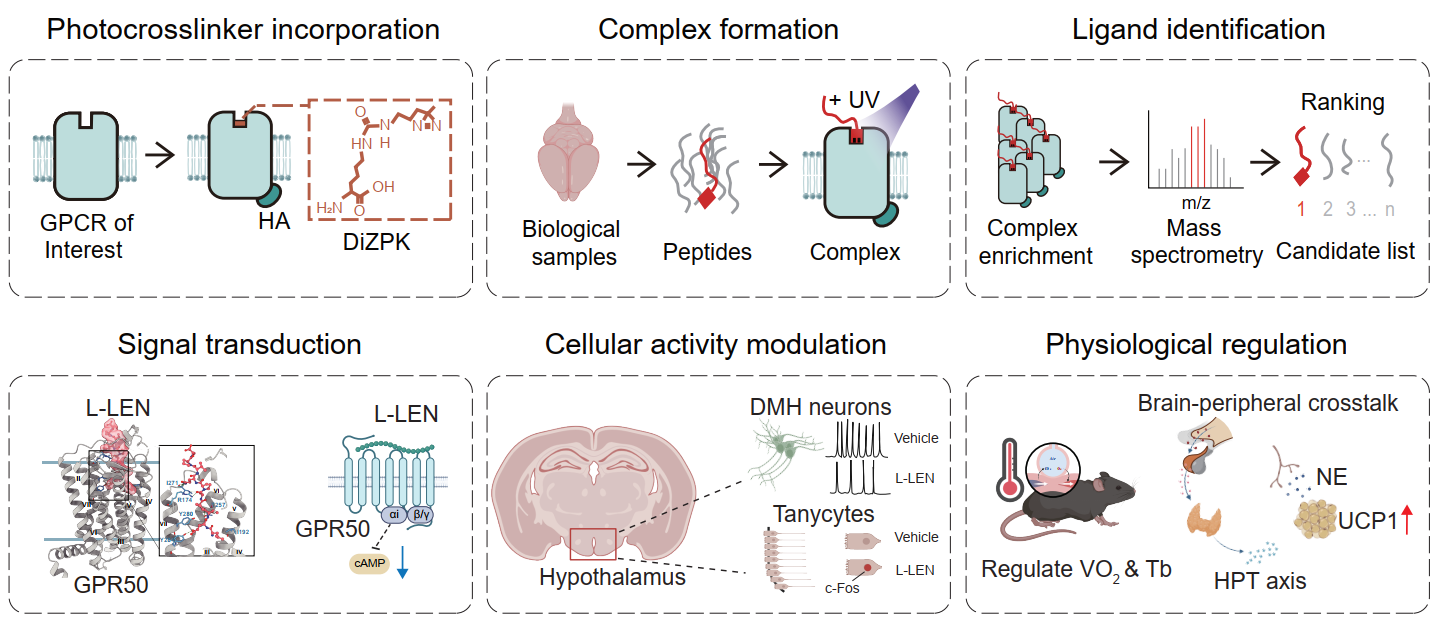
G protein-coupled receptors (GPCRs) are among the most important signal transducers in physiology and drug discovery, yet many receptors remain orphan, with their endogenous ligands still unknown. In this work, we established a generalizable photo-cross-linking-assisted GPCR deorphanization platform that enables effective ligand capture directly from native biological extracts under physiologically relevant conditions. By combining site-specific incorporation of photo-cross-linkers with complementary proteomic and cross-linked peptidomic analyses, this modular strategy provides an efficient route for identifying endogenous ligand–receptor pairs in complex biological contexts.
Using this platform, we successfully deorphanized the metabolism-related receptor GPR50 and identified the neuropeptide Little-LEN (L-LEN) as its endogenous ligand. We further showed that L-LEN selectively binds GPR50, activates downstream Gαi signaling, and modulates cellular activities across multiple biological scales.
Importantly, in behaving mice, L-LEN–GPR50 signaling functionally coordinates metabolic adaptation through brain–body, including brain–adipose, cross-talk. Deficiency of either L-LEN or GPR50 increased the likelihood of torpor under metabolic challenge, while central delivery of L-LEN reversed fasting-induced reductions in metabolic rate and body temperature in wild-type but not Gpr50-knockout mice. Together, this study not only reveals the endogenous ligand and physiological function of GPR50, but also provides a versatile platform for future deorphanization of orphan GPCRs and for probing disease-relevant ligand–receptor interactions directly from native samples. Congratulations to Rui Wu and Na Li for their excellent contributions, and also for other lab members and collaborators for support!
Check out our paper at here:
https://www.nature.com/articles/s41589-025-02098-6